
 Turkey
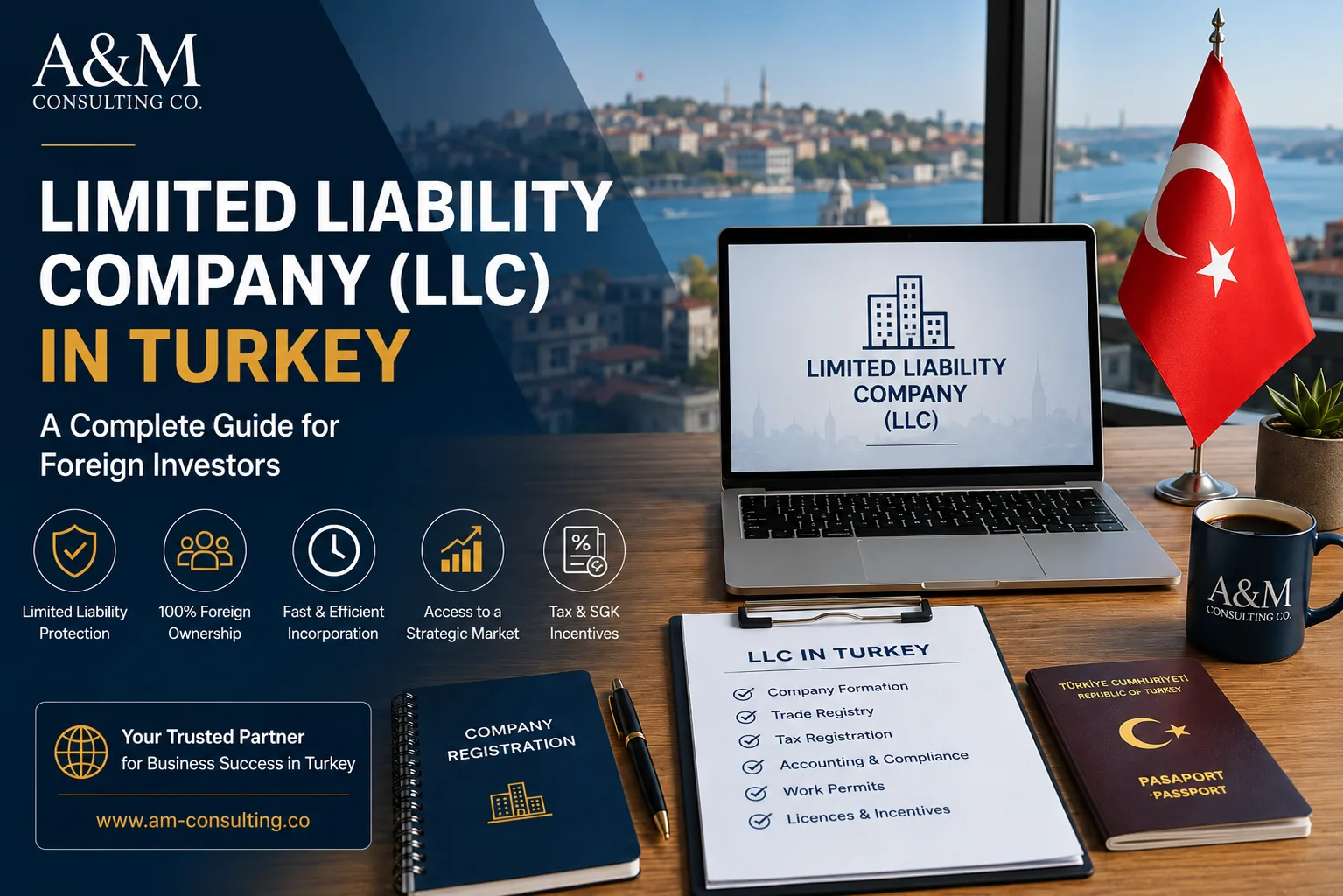
Foreign investors can establish a Limited Liability Company (Ltd. Şti.) in Turkey with 100% foreign ownership, subject to any sector-specific restrictions. The incorporation process generally involves choosing the company name and activities, preparing the Articles of Association, completing MERSIS registration, filing with the Trade Registry, completing applicable tax and other registrations, and establishing corporate banking arrangements.
For many international investors, a Turkish LLC is a practical structure for trading, services, technology, e-commerce, consulting and other commercial activities. The process can often be coordinated remotely through a properly prepared Power of Attorney, although corporate bank account opening remains subject to each bank’s KYC and physical-presence requirements.
This guide explains the process step by step, including the documents required, minimum capital, MERSIS, Trade Registry, Power of Attorney, foreign documents, tax registration, banking, timelines and post-incorporation compliance.
Advisory note: This article explains the incorporation process from a practical business and advisory perspective. Specific legal, tax, licensing and banking requirements can vary depending on the investor, sector, ownership structure and location. Always confirm current requirements with the relevant Turkish authorities and the selected bank.
Quick Checklist: Steps to Register an LLC in Turkey
The process can be summarized as follows:
- Choose the company type, name and business activities.
- Determine the shareholders and manager structure.
- Prepare the Articles of Association.
- Prepare a Power of Attorney if incorporation will be handled remotely.
- Apostille or legalize foreign documents where required.
- Complete the MERSIS application.
- Submit the incorporation documents to the Trade Registry.
- Complete company registration and Trade Registry Gazette publication.
- Complete tax and other applicable registrations.
- Open the corporate bank account.
- Set up accounting, e-invoice/e-ledger and other ongoing compliance systems.
The Turkish Ministry of Trade confirms that MERSIS is used to conduct company registration and other Trade Registry transactions electronically
What Is a Limited Liability Company in Turkey?
A Turkish Limited Liability Company, commonly referred to as a Ltd. Şti. (Limited Şirket), is a company whose capital is divided into shares and whose shareholders’ liability is generally limited to their capital commitments and other statutory or contractual obligations.
The Turkish Limited Liability Company is regulated primarily under the Turkish Commercial Code No. 6102.
For foreign investors, the structure is particularly attractive because:
- A company can have a single shareholder.
- The maximum number of shareholders is 50.
- Shareholders can be individuals or legal entities.
- Foreign investors can generally own 100% of the company.
- A Turkish partner is not generally required for ordinary commercial activities.
- The company can conduct trading, services, technology, e-commerce and many other business activities.
- Management can be structured around one or more managers.
The Turkish Ministry of Trade confirms that an LLC may have one shareholder and no more than 50 shareholders, and that shareholders may be natural or legal persons.
For a more detailed explanation of the structure, advantages and requirements, see:
Limited Liability Company in Turkey – A&M Consulting Co.
100% Foreign Ownership
A foreign investor does not generally need a Turkish shareholder to establish an LLC.
A Turkish LLC can therefore be structured with:
- One foreign individual shareholder;
- Multiple foreign individual shareholders;
- One foreign corporate shareholder;
- Multiple foreign corporate shareholders; or
- A combination of foreign individuals and companies.
However, investors should always check whether the intended business activity is subject to sector-specific ownership, licensing or regulatory restrictions.
Company Manager Requirements
A Turkish LLC may have one or more managers.
Importantly, Turkish Commercial Code Article 623 provides that at least one shareholder must have the right to manage and represent the company. At the same time, the management and representation structure may also include other persons, including third-party managers.
Therefore, the management structure should be planned carefully when the company is being incorporated.
Why Do Foreign Investors Choose an LLC in Turkey?
A Turkish LLC is commonly preferred by foreign investors because it provides a relatively straightforward corporate structure while allowing foreign ownership.
It may be suitable for:
- International trading companies;
- Import and export businesses;
- E-commerce companies;
- Technology and software businesses;
- Consulting companies;
- Service providers;
- Marketing agencies;
- Regional headquarters;
- Foreign companies establishing Turkish subsidiaries;
- Businesses employing personnel in Turkey.
Investors considering a larger corporate structure can also compare the LLC with a Joint Stock Company:
Joint Stock Company in Turkey – A&M Consulting Co.
Minimum Capital for a Limited Liability Company in Turkey
The statutory minimum capital for a Turkish Limited Liability Company is currently TRY 50,000.
The minimum was increased from TRY 10,000 to TRY 50,000 effective 1 January 2024 under Presidential Decision No. 7887.
The capital amount should be stated in the Articles of Association.
Share Capital in Turkey – A&M Consulting Co.
Does the Capital Have to Be Paid Before Incorporation?
For a Turkish LLC, cash capital does not generally have to be fully paid before registration.
The Ministry of Trade’s guide states that the cash capital of a Limited Company can be paid within 24 months following registration, unless a different payment schedule is provided in the Articles of Association or determined by the managers.
This is an important distinction for foreign investors because the statutory minimum capital should not be confused with an obligation to transfer the entire amount before the company is registered.
The appropriate capital payment structure should nevertheless be determined during incorporation based on the company’s Articles of Association and the specific circumstances of the transaction.
Requirements to Register an LLC in Turkey
Before starting the incorporation application, the investor should determine the following:
1. Shareholders
The company must have at least one shareholder and may have up to 50 shareholders.
2. Company Manager
The management structure must comply with Turkish Commercial Code requirements, including the requirement that at least one shareholder has management and representation authority.
3. Registered Office
The company must have a registered address in Turkey.
This can be a commercial office or, where legally and commercially appropriate, a professional registered/virtual office arrangement.
Virtual Office in Turkey – A&M Consulting Co.
4. Business Activities
The intended activities should be clearly defined in the Articles of Association and should correspond with the company’s actual business model.
Certain sectors may require additional licenses or approvals.
5. Share Capital
The minimum statutory capital for an LLC is TRY 50,000, although investors may choose a higher amount depending on the business model, banking requirements, investment structure or work-permit considerations.
6. Tax Identification
Foreign shareholders and managers may require Turkish tax identification numbers or other identification details depending on their circumstances and the registration or banking process.
Documents Required to Establish an LLC in Turkey
The exact documentation varies depending on whether the shareholders are individuals or companies.
Typical documents may include:
- Passport copies of foreign individual shareholders;
- Passport or identification documents of managers;
- Articles of Association;
- Company address information;
- Manager appointment information;
- Signature declarations;
- Power of Attorney, where applicable;
- Corporate documents of foreign company shareholders;
- Board or shareholder resolutions of foreign corporate shareholders;
- Certificates showing the foreign company’s current legal status;
- Apostilled or legalized foreign documents;
- Turkish sworn translations and notarizations where required.
The official Invest in Türkiye guidance confirms that foreign corporate shareholders may need corporate registry documents and relevant corporate resolutions, while foreign documents generally require authentication and Turkish translation/notarization.
Power of Attorney for Remote Company Formation in Turkey
Foreign investors do not necessarily need to travel to Turkey to complete every stage of company incorporation.
A properly prepared Power of Attorney (POA) can allow an authorized representative in Turkey to handle incorporation formalities on behalf of the investor.
The POA should be drafted carefully because an authority omitted from the document may require a new document and create unnecessary delays.
Depending on the transaction, the POA may authorize the representative to:
- Establish the company;
- Sign the Articles of Association;
- Complete MERSIS procedures;
- Submit documents to the Trade Registry;
- Represent the shareholder before government authorities;
- Complete tax registration;
- Obtain relevant tax numbers;
- Complete manager appointment procedures;
- Handle capital-related procedures;
- Assist with banking procedures, subject to the bank’s own requirements.
Apostille and Legalization of Foreign Documents
Foreign documents used in Turkish company formation generally need to be authenticated.
Where the issuing country is a party to the Hague Apostille Convention, an apostille may be used.
Where apostille procedures do not apply, consular legalization or another applicable authentication procedure may be required.
The authenticated document may then need to be translated into Turkish and notarized in Turkey.
The exact procedure depends on the country where the document was issued.
Step-by-Step Process to Register a Limited Liability Company in Turkey
Step 1: Choose the Company Name and Business Activities
The first step is to determine:
- Company name;
- Business activities;
- Registered office;
- Shareholders;
- Shareholding percentages;
- Share capital;
- Manager(s);
- Representation and signing authority.
The proposed activities should be reviewed before incorporation because certain activities require licenses or special approvals.
Step 2: Prepare the Articles of Association
The Articles of Association establish the legal framework of the company.
They generally address matters such as:
- Company name;
- Registered office;
- Business purpose and activities;
- Capital;
- Shareholding;
- Management;
- Representation;
- Company duration and other statutory matters.
The information in the Articles of Association must be consistent with the MERSIS application and Trade Registry documents.
Step 3: Prepare the Power of Attorney for Remote Incorporation
If the foreign investor will not travel to Turkey, the POA should be prepared and authenticated before the incorporation process begins.
This is often one of the most important preparatory steps for a remote incorporation.
A&M Consulting Co. assists foreign investors with the preparation and coordination of company incorporation documentation and related procedures.
Company Registration in Turkey – A&M Consulting Co.
Step 4: Register the Company in MERSIS
MERSIS (Central Registry Record System) is the Turkish Ministry of Trade’s central electronic system for company and Trade Registry transactions.
Company information, shareholders, managers, Articles of Association and other registration information are entered into the system.
MERSIS assigns a unique number to the company and forms an important part of the incorporation process.
MERSIS – Republic of Türkiye Ministry of Trade
Step 5: Submit the Application to the Trade Registry
Once the MERSIS information has been prepared, the incorporation file is submitted to the competent Trade Registry Office.
The file may include:
- Articles of Association;
- Identification documents;
- Manager information;
- Signature declarations;
- Power of Attorney;
- Foreign corporate documents;
- Address information;
- Other documents required by the relevant Trade Registry.
The official Istanbul Chamber of Commerce guidance confirms that foreign documents may require apostille or consular authentication followed by official Turkish translation and notarization.
Step 6: Complete Company Registration
Once the Trade Registry approves the application, the company is registered as a Turkish legal entity.
The incorporation information is subsequently published in the Turkish Trade Registry Gazette.
Turkish Trade Registry Gazette
At this point, the company has been legally established, but several operational and compliance steps may still need to be completed.
Step 7: Complete Tax Registration
Following incorporation, the company becomes subject to the applicable Turkish tax and reporting framework.
The Revenue Administration (GİB) administers Turkish tax procedures.
Depending on the company’s activities, this may involve:
- Corporate income tax;
- VAT;
- Withholding tax;
- E-invoice;
- E-archive;
- E-ledger;
- Other electronic tax applications.
Tax Services in Turkey – A&M Consulting Co.
For foreign-owned companies, tax compliance should be planned from the beginning rather than after commercial operations have already started.
Tax Compliance in Turkey for Foreign Companies – A&M Consulting Co.
Step 8: Complete SGK and Other Applicable Registrations
If the company will employ personnel, employer registration and social security compliance must be addressed.
This includes:
- SGK employer registration;
- Employee registrations;
- Payroll;
- Monthly social security declarations;
- Employment-related compliance.
Social Security Registration in Turkey – A&M Consulting Co.
For companies employing foreign or Turkish personnel:
HR and Payroll Services in Turkey for Foreign Companies – A&M Consulting Co.
Where the business activity or premises requires a municipal license, the relevant municipal procedures should also be completed.
Corporate Bank Account for a Turkish LLC
Opening a corporate bank account is one of the stages that can take longer than the company registration itself.
Banks conduct their own KYC, AML and compliance checks.
A bank may request:
- Trade Registry documents;
- Articles of Association;
- Tax number;
- Signature circular/declarations;
- Passport and identification documents;
- Information about shareholders and ultimate beneficial owners;
- Information about the company’s activities;
- Source-of-funds information;
- Business plan or commercial documents.
Each bank applies its own onboarding procedures.
Corporate Bank Account Opening in Turkey – A&M Consulting Co.
Can Foreigners Open a Turkish Corporate Bank Account Remotely?
There is no universal rule that guarantees remote corporate bank account opening for every foreign-owned company.
Some banks may require an authorized manager or representative to attend a branch for identity verification and KYC.
Therefore, investors should determine the bank’s requirements before choosing their incorporation and banking structure.
This is one reason why company incorporation and bank account opening should be treated as related but separate processes.
Tax, Accounting and Post-Incorporation Compliance
Registering the company is only the beginning of operating a Turkish business.
A Turkish LLC may need to establish systems for:
- Accounting;
- Bookkeeping;
- VAT;
- Corporate income tax;
- Withholding tax;
- E-invoice;
- E-archive;
- E-ledger;
- Payroll;
- SGK;
- Annual corporate compliance;
- Financial reporting.
Accounting & Bookkeeping Services in Turkey – A&M Consulting Co.
Foreign investors should therefore arrange their accounting and tax compliance structure before commercial activity begins.
How Long Does It Take to Register an LLC in Turkey?
The legal incorporation itself can often be completed relatively quickly once the documents are ready.
However, the overall timeline depends on:
- Preparation of foreign documents;
- Apostille/legalization;
- Turkish translations;
- POA preparation;
- MERSIS;
- Trade Registry appointment and processing;
- Tax procedures;
- Banking;
- Sector-specific licensing.
A practical indicative timeline may look like this:
| Stage | Typical timeframe |
|---|---|
| Company planning and name | 1–2 days |
| Document preparation | 1–7 days |
| Apostille/legalization | 2–10 days |
| MERSIS and Trade Registry | Several business days |
| Company registration/Gazette | Shortly after approval |
| Tax and related registrations | Depending on circumstances |
| Corporate bank account | Several days to several weeks |
The bank account opening stage is often the least predictable part of the process.
How Much Does It Cost to Establish an LLC in Turkey?
The total cost depends on the structure and services required.
Typical cost categories include:
- Trade Registry fees;
- Notary fees;
- Turkish translation fees;
- Apostille/legalization costs;
- Signature declaration fees;
- Registered office costs;
- Professional incorporation fees;
- Accounting and tax compliance;
- Banking-related costs;
- Sector-specific licenses, where applicable.
There is therefore no single universal “company formation cost” applicable to every foreign investor.
Investors should distinguish between official government/third-party costs and professional service fees.
Common Mistakes When Registering an LLC in Turkey
1. Using an Incomplete Power of Attorney
A POA that does not authorize a required procedure can cause delays and require additional documentation.
2. Incorrect Business Activities
Choosing activities that do not accurately reflect the intended business model can create problems later.
3. Inconsistent Foreign Documents
Names, addresses, company numbers and corporate information should be consistent across all documents.
4. Ignoring Apostille and Translation Requirements
Foreign documents may require authentication and Turkish translation before they can be used in Turkey.
5. Assuming Bank Account Opening Is Automatic
Company registration does not guarantee that a particular bank will accept the company’s account application.
6. Delaying Tax and E-Compliance Setup
Tax, accounting, e-invoice and e-ledger requirements should be assessed immediately after incorporation.
7. Ignoring Sector-Specific Licenses
Some industries have additional regulatory requirements that go beyond ordinary company incorporation.
8. Choosing the Wrong Company Structure
An LLC is not automatically the best structure for every investor.
Businesses expecting significant capital raising, complex investment structures or capital-market activity may need to evaluate a Joint Stock Company instead.
LLC vs Joint Stock Company in Turkey
| Feature | Limited Liability Company | Joint Stock Company |
|---|---|---|
| Minimum capital | TRY 50,000 | TRY 250,000 |
| Shareholders | 1–50 | Minimum 1 |
| Foreign ownership | Generally 100% | Generally 100% |
| Management | Manager(s) | Board of Directors |
| Minimum shareholder-manager relationship | At least one shareholder must have management and representation authority | Different board structure |
| Typical use | SMEs, trading, services, technology | Larger investments, complex structures |
| Public offering | Not available | Possible subject to applicable rules |
| Governance | Generally simpler | Generally more formal |
The minimum capital figures for LLCs and JSCs are based on the Ministry of Trade’s current published information.
For investors specifically evaluating the incorporation process, see:
Company Registration in Turkey – A&M Consulting Co.
Post-Incorporation Checklist for Foreign Investors
After the LLC is registered, investors should consider the following checklist:
- Obtain the Trade Registry extract.
- Obtain the Trade Registry Gazette publication.
- Confirm tax registration.
- Confirm the registered office.
- Complete applicable SGK registration.
- Determine VAT obligations.
- Set up e-invoice/e-ledger systems where required.
- Appoint an accountant/accounting firm.
- Open the corporate bank account.
- Establish bookkeeping procedures.
- Arrange payroll if employees will be hired.
- Check municipal and sector-specific licenses.
- Review foreign employee work-permit requirements where applicable.
For foreign investors employing personnel in Turkey:
Work Permit in Turkey – A&M Consulting Co.
Can Foreigners Register a Turkish LLC Remotely?
Yes, in many cases.
A foreign investor may be able to complete the incorporation process without travelling to Turkey by granting an appropriately drafted Power of Attorney to a local representative.
The remote process typically involves:
- Preparing the company structure;
- Preparing the POA;
- Notarization and apostille/legalization;
- Turkish translation where required;
- MERSIS registration;
- Trade Registry filing;
- Company registration;
- Tax and other registrations;
- Corporate banking.
However, remote incorporation should not be confused with guaranteed remote banking.
The company can potentially be incorporated remotely while the selected bank may still require physical attendance by an authorized person.
Why Professional Assistance Can Be Valuable
For a foreign investor, company formation is not simply a matter of submitting a registration form.
The incorporation structure affects:
- Shareholding;
- Management;
- Tax registration;
- Banking;
- Accounting;
- Payroll;
- Work permits;
- Licensing;
- Future capital increases;
- Share transfers;
- Corporate compliance.
For this reason, many foreign investors prefer to coordinate incorporation, accounting, tax and compliance through a single local advisory firm.
A&M Consulting Co. – Turkey Business, Accounting and Tax Services
Need Professional Advice?
Registering a Turkish Limited Liability Company involves more than completing the Trade Registry application. Foreign investors also need to consider shareholding, management, Power of Attorney, foreign document legalization, tax registration, corporate banking, accounting, social security and ongoing compliance.
If you are planning to establish a Turkish LLC and want practical assistance with the incorporation process, A&M Consulting Co. can assist with company registration and related tax, accounting, banking and compliance procedures.
Learn more about Limited Liability Company Registration in Turkey
Sources
- Turkish Commercial Code No. 6102 (Türk Ticaret Kanunu)
Turkish Commercial Code No. 6102 – Mevzuat - Republic of Türkiye Ministry of Trade – Companies
Ministry of Trade – Companies - Republic of Türkiye Ministry of Trade – Frequently Asked Questions: Companies
Ministry of Trade – Frequently Asked Questions: Companies - Republic of Türkiye Ministry of Trade – Guide for Foreign Investors
Ministry of Trade – Guide for Foreign Investors - MERSİS – Central Registry Record System
MERSİS – Ministry of Trade - Invest in Türkiye – Establishing a Business
Invest in Türkiye – Establishing a Business - Türkiye Trade Registry Gazette – Türkiye Ticaret Sicili Gazetesi
Türkiye Trade Registry Gazette - Republic of Türkiye Revenue Administration (GİB)
Revenue Administration – GİB - Republic of Türkiye Official Gazette – Resmî Gazete
Official Gazette – Resmî Gazete - Republic of Türkiye Ministry of Trade – MERSİS
MERSİS – Central Registry Record System